
Health Insurance Myths That Lead Americans to Make Costly Coverage Decisions

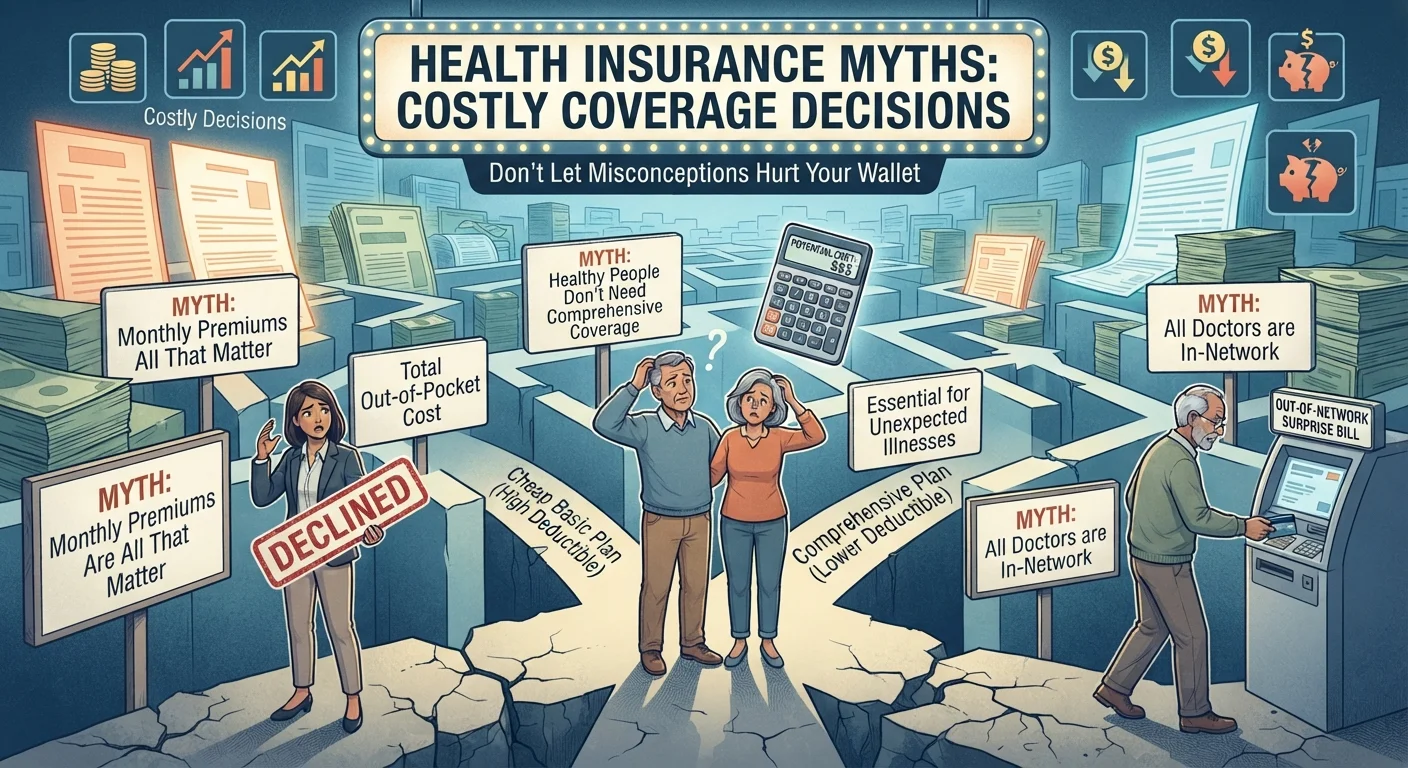
Understanding what your health plan actually covers can prevent expensive surprises later.
From "I am healthy so I do not need coverage" to misreading in-network rules, these common myths can leave you underinsured.
Why these myths cost real money
Health insurance decisions based on incomplete information tend to show up later as denied claims, surprise bills, or gaps in coverage during the moments that matter most. Many of the most common misconceptions are not obvious errors; they are plausible-sounding ideas that do not hold up against how coverage actually works. This article addresses those misconceptions directly so you can make decisions with accurate information.
This article is general health insurance information and education, not personalized insurance or financial advice. Coverage terms, costs, and eligibility vary by plan and by state. Always consult a licensed insurance agent or your plan documents before making coverage decisions.
Myth
I am young and healthy, so I do not need health insurance.
Fact
Medical emergencies and sudden diagnoses happen at every age. Without coverage, a single hospitalization can produce bills that take years to resolve.
Routine good health does not predict what will happen in the next twelve months. Accidents, appendicitis, a broken bone from a weekend activity, or an unexpected diagnosis can generate hospital charges that run into tens of thousands of dollars. Health insurance is not primarily a tool for managing everyday costs; it is financial protection against high-cost, unpredictable events. Going without coverage also means no access to preventive screenings that catch problems before they become expensive to treat. If cost is the concern, income-based subsidies through the ACA marketplace or Medicaid eligibility may bring monthly premiums lower than many people expect.
Myth
Any doctor who takes insurance will be covered by my plan.
Fact
Only providers in your plan's network are covered at the in-network rate. Seeing an out-of-network provider often means paying a much larger share of the bill, and some plans pay nothing at all for out-of-network care.
Health plans contract with specific providers to form a network. Your cost-sharing obligations (the deductible, copay, and coinsurance you pay) are calculated based on whether your provider is inside that network. A physician can accept insurance in general but still be outside your specific plan's network. Network status can also change during the year when a provider renegotiates or ends a contract with an insurer. Before scheduling a procedure or specialist visit, confirm network status directly with both your insurer and the provider's billing office. This is especially relevant for HMO and EPO plans, which typically provide no coverage for out-of-network care except in emergencies.
Myth
If I miss Medicare's initial enrollment window, I can sign up whenever I want.
Fact
Late enrollment in Medicare Part B and Part D triggers permanent premium surcharges that increase the longer enrollment is delayed.
Medicare has specific enrollment periods. The Initial Enrollment Period (IEP) runs for seven months centered on your 65th birthday month. Missing it without qualifying for a Special Enrollment Period (SEP) results in a late enrollment penalty on Part B premiums of 10% for each full 12-month period you were eligible but not enrolled. The penalty is permanent and added to the standard premium for as long as you have Part B. Part D (prescription drug coverage) carries a similar ongoing penalty. The main exception is for people who are still covered by an employer group plan through active employment; that coverage qualifies them for a Special Enrollment Period when that employment ends. This rule surprises many people who retired before 65 and assumed they had a long window to enroll.
Myth
A short-term health plan works as a real safety net if I am between jobs.
Fact
Short-term plans are not required to comply with ACA consumer protections. They can deny coverage based on pre-existing conditions and do not have to cover essential health benefits.
Short-term health plans are designed to cover gaps of a few months, not to function as full insurance. They often exclude pre-existing conditions, have annual or lifetime benefit caps, and do not cover maternity care, mental health services, or prescription drugs in the way ACA-compliant plans must. If you file a claim for a condition you had before enrollment, the insurer may deny it. What short-term plans typically do and do not cover walks through those limitations in detail. If you lose job-based coverage, checking ACA marketplace Special Enrollment Period eligibility is worth doing before defaulting to a short-term product.
Myth
Adding a family member to my employer plan is always the most affordable choice.
Fact
Employer plans often charge full premiums for dependents, with no employer contribution. A spouse or child may qualify for lower-cost ACA marketplace coverage or Medicaid separately.
Many employers cover a substantial portion of the employee's premium but contribute little or nothing toward dependent coverage. The full dependent premium comes out of the employee's paycheck. If a spouse or child is not offered affordable coverage through their own employer, they may be eligible for marketplace subsidies or Medicaid depending on household income. The ACA's affordability rules are calculated based on the employee-only premium, not the family premium, which means dependents can sometimes qualify for marketplace subsidies even when the employee does not. Comparing the total annual cost of employer-based family coverage against marketplace options during open enrollment is a straightforward way to check whether the employer plan is the lower-cost path.
Myth
My health plan covers everything after I hit my deductible.
Fact
After the deductible, most plans require you to continue paying coinsurance or copays until you reach the out-of-pocket maximum. Only after that maximum is met does the plan typically cover 100% of in-network costs.
The deductible is the amount you pay before your insurer begins sharing costs. Once it is met, you generally move into a cost-sharing phase where the plan pays a percentage (commonly 70% to 80%) and you pay the remainder as coinsurance. This continues until you reach the plan's out-of-pocket maximum for the year. After that maximum is reached, the plan covers in-network covered services at 100% for the rest of the plan year. Understanding the relationship between deductible, coinsurance, and out-of-pocket maximum helps you estimate realistic exposure for a high-cost medical event rather than assuming costs stop at the deductible amount.
Coverage situations that trip up seniors specifically
Medicare has its own set of widely misunderstood rules, and the financial consequences of getting them wrong can follow an enrollee for years. The coverage situations that most often surprise Medicare enrollees deserve separate attention because the enrollment rules differ substantially from employer and marketplace plans.
Medicare penalty windows close quickly
If you are turning 65 and not covered by an active employer group plan, your Initial Enrollment Period is seven months long and does not reset. Delaying Part B enrollment without a qualifying reason results in a permanent premium surcharge. Contact the Social Security Administration or your State Health Insurance Assistance Program (SHIP) counselor to confirm your specific window before it closes.
Medicaid eligibility and long-term care coverage are also frequently misread. The rules around asset limits, spousal protections, and what Medicaid actually pays for in a nursing home setting are more complex than most people expect. See common misconceptions about Medicaid and long-term care for a detailed look at how those rules work.
Reading your Explanation of Benefits after each claim is one practical way to catch billing errors early. Understanding your Explanation of Benefits statement explains what each section means and what to do if numbers do not match your expectations.
The content provided on our blog site traverses numerous categories, offering readers valuable and practical information. Readers can use the editorial team’s research and data to gain more insights into their topics of interest. However, they are requested not to treat the articles as conclusive. The website team cannot be held responsible for differences in data or inaccuracies found across other platforms. Please also note that the site might also miss out on various schemes and offers available that the readers may find more beneficial than the ones we cover.