
Social Security Retirement vs. Disability Benefits: Key Differences

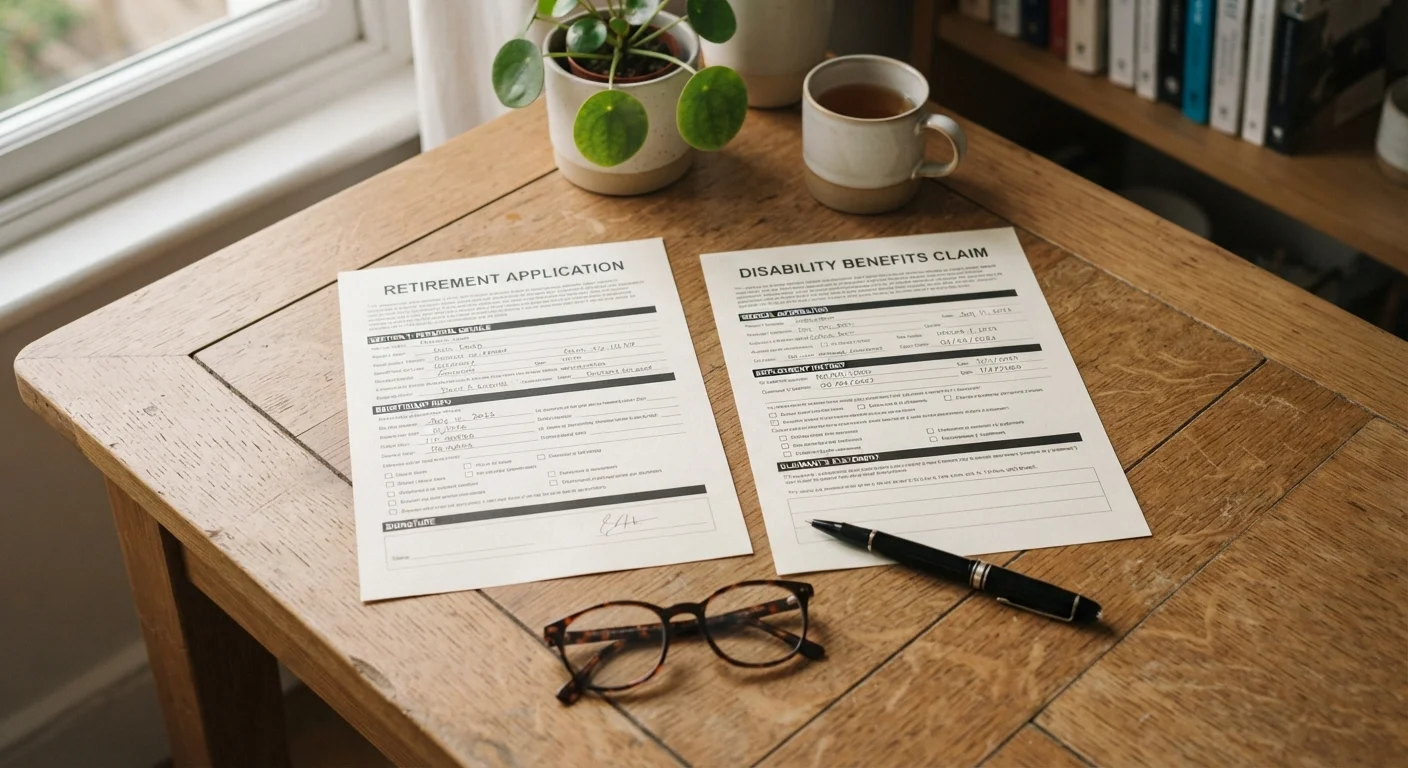
Understand how Social Security retirement and disability benefits differ in eligibility, timing, and payment calculations.
Option A
Social Security Retirement Benefits
Income for workers who have reached a qualifying age after a full career.
Best for: Workers approaching or past their early 60s who have accumulated enough work credits and want to begin receiving age-based income.
Option B
Social Security Disability Benefits (SSDI)
Income for workers whose medical condition prevents them from working.
Best for: Workers of any eligible age who have a qualifying disability that is expected to last at least 12 months or result in death.
How eligibility works for each program
Social Security Retirement Benefits become available starting at age 62, though claiming before your full retirement age (which ranges from 66 to 67 depending on birth year) reduces the monthly amount permanently. To qualify, you generally need 40 work credits, the equivalent of about 10 years of covered employment.
Social Security Disability Insurance (SSDI) has no minimum age, but it does require a specific number of work credits that varies by how old you are when the disability begins. Younger workers need fewer credits. Beyond credits, the Social Security Administration must determine that your condition meets its definition of disability: an inability to perform substantial gainful activity due to a medically determinable impairment lasting at least 12 months or expected to result in death.
That medical standard is the most significant difference in eligibility. Retirement requires age and work history. SSDI requires both a work history and documented medical evidence reviewed by the SSA.
| Criterion | Retirement Benefits | SSDI |
|---|---|---|
| Eligibility basis | Age and work credits | Disability and work credits |
| Earliest age to receive | 62 | Any age with enough credits |
| Medical review required | No | Yes, full SSA evaluation |
| Payment amount | Reduced if claimed before full retirement age | Full PIA at any age |
| Medicare eligibility | Age 65 | After 24 months of SSDI |
| Application complexity | Straightforward | Detailed; appeals common |
| Automatic conversion | N/A | Converts to retirement at full retirement age |
How monthly payments are calculated
Both programs base their calculations on your average indexed monthly earnings (AIME), which reflects your highest-earning years adjusted for wage inflation. The SSA then applies a formula to arrive at your primary insurance amount (PIA), the baseline figure for monthly payments.
For retirement, claiming early permanently reduces that amount. Delaying past full retirement age increases it, up to age 70. For SSDI, you receive your full PIA regardless of age, because the program treats disability as equivalent to reaching full retirement age in terms of benefit calculation.
This means a 50-year-old approved for SSDI may receive a higher monthly amount than the same person would get claiming retirement benefits early at 62. For context on how Social Security fits into a broader financial picture, see retirement income sources every senior should understand.
Medicare and other program connections
Medicare eligibility normally begins at age 65. SSDI recipients, however, become eligible for Medicare after receiving disability benefits for 24 consecutive months. That waiting period can be a significant gap for people who cannot work and lack other coverage.
Retirement beneficiaries enroll in Medicare at 65 on the standard timeline. Those who claim retirement benefits early (before 65) must arrange other health coverage in the interim.
SSDI and the full retirement age transition
When an SSDI recipient reaches their full retirement age, the SSA converts the disability benefit to a retirement benefit automatically. The monthly payment amount stays the same. No separate application is required for this conversion, and it does not affect Medicare enrollment if the recipient is already enrolled.
When an SSDI recipient reaches full retirement age, the SSA automatically converts the disability benefit to a retirement benefit. The monthly amount does not change at that transition. If you are approaching that age and currently receive SSDI, no separate application is needed.
Medicaid, a separate program, has its own eligibility rules and sometimes intersects with both retirement and disability situations. For more on that topic, see common misconceptions about Medicaid and long-term care.
Applying and what to expect
Applying for retirement benefits is relatively direct. You can apply online through the SSA website, by phone, or in person at a local SSA office, generally up to four months before you want benefits to start.
Applying for SSDI is more involved. The SSA requires medical records, statements from treating providers, and documentation of how your condition affects daily functioning and work capacity. Initial decisions typically take three to six months. A significant share of initial applications are denied; many applicants pursue appeals, some through an administrative law judge hearing. Working with a Social Security attorney or advocate during the appeals process is common, and fees for such representation are regulated by the SSA.
For anyone weighing long-term financial planning alongside these decisions, retirement account types explained covers how other savings vehicles interact with income in later life.
This article is for general informational purposes only and is not financial, legal, or medical advice. Eligibility rules, benefit amounts, and program details can change. Contact the Social Security Administration directly or consult a licensed professional for guidance specific to your situation.
The content provided on our blog site traverses numerous categories, offering readers valuable and practical information. Readers can use the editorial team’s research and data to gain more insights into their topics of interest. However, they are requested not to treat the articles as conclusive. The website team cannot be held responsible for differences in data or inaccuracies found across other platforms. Please also note that the site might also miss out on various schemes and offers available that the readers may find more beneficial than the ones we cover.