

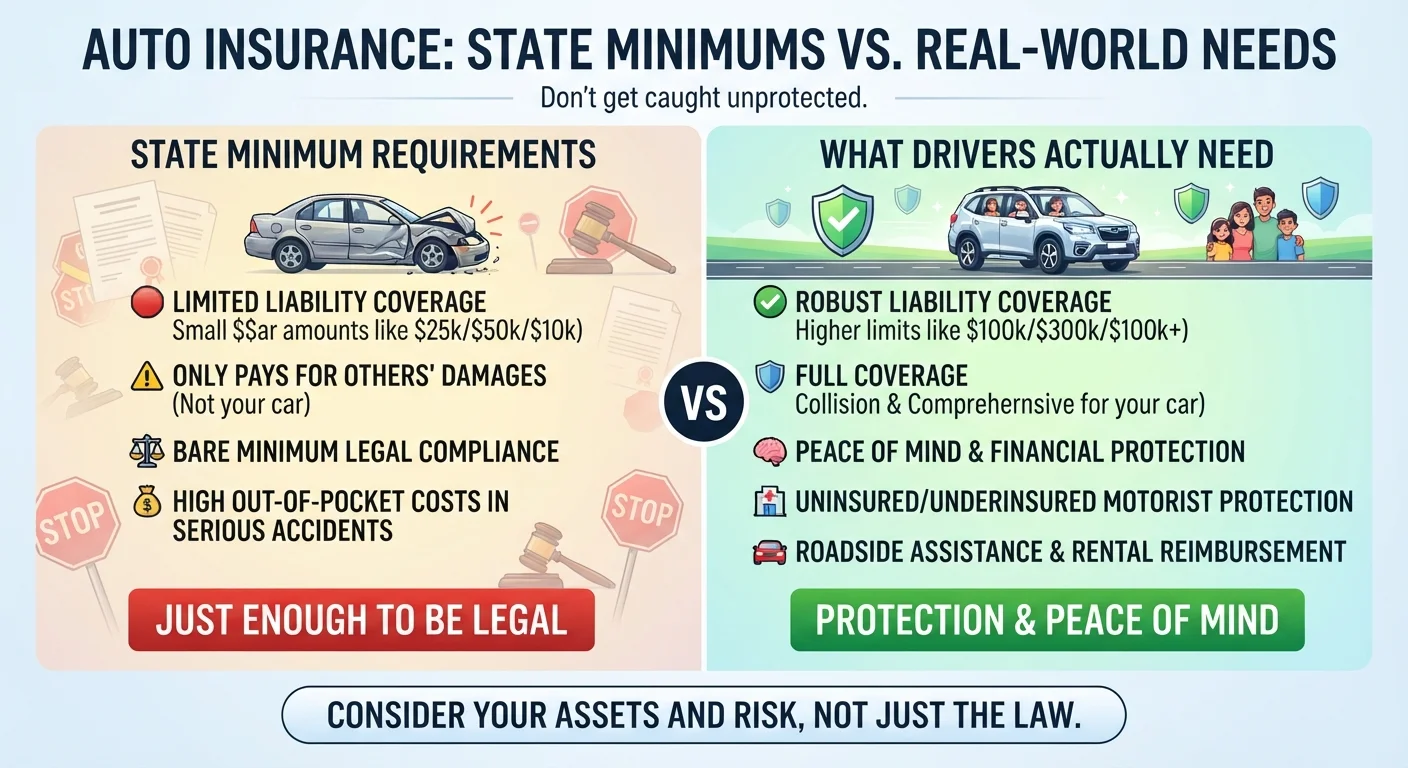
Meeting your state's legal minimum keeps you street legal, but it may leave real gaps. This article explains where minimums fall short and why.
Our Verdict
State minimum coverage keeps you legal, but it leaves your own vehicle and finances exposed in many common accident scenarios. Drivers with financed vehicles, significant savings, or regular highway driving typically have more to lose than minimums protect. The right level of coverage depends on your specific assets, vehicle value, and risk tolerance, and a licensed insurance agent can help you work through that math.
| Best for | Recommended |
|---|---|
| Drivers with older paid-off vehicles and limited assets | State minimum coverage |
| Drivers with financed or leased vehicles | Full coverage (collision, comprehensive, and liability above minimums) |
| Drivers with significant personal assets to protect | Higher liability limits with umbrella consideration |
| Drivers in states with high rates of uninsured motorists | Uninsured/underinsured motorist coverage added to any base policy |
What state minimums actually cover
Every state except New Hampshire requires drivers to carry some form of auto insurance. Most states require liability coverage, which pays for injuries and property damage you cause to other people. It does not pay to repair your car, and it does not cover your own medical bills after a crash.
Liability coverage is expressed as three numbers, such as 25/50/25. The first number is the per-person bodily injury limit (in thousands), the second is the per-accident bodily injury limit, and the third is the property damage limit. A 25/50/25 policy pays up to $25,000 per injured person, $50,000 total for all injuries in one accident, and $25,000 for property damage.
Some states also require personal injury protection (PIP) or medical payments coverage (MedPay), which pay for your own medical costs regardless of fault. A smaller number of states require uninsured motorist coverage. Beyond those additions, the base legal requirement in most states is liability only.
Where minimums fall short
The liability limits set by most states were written decades ago and have not kept pace with the actual cost of medical care or vehicle repairs. A single hospitalization after a serious crash can easily exceed $50,000, and many late-model vehicles cost $30,000 or more to replace. If your policy limits are exhausted, the injured party can pursue your personal assets to cover the remaining balance.
Minimum coverage also leaves your own vehicle completely unprotected. If you cause an accident, liability pays the other driver. Collision coverage, which is optional in most states, is what pays to repair or replace your car. Without it, you bear that cost yourself.
Comprehensive coverage works similarly: it covers theft, weather damage, and other non-collision events. Neither collision nor comprehensive is required by state law, but lenders typically require both when you finance or lease a vehicle.
Low limits can leave you personally exposed
If damages from an at-fault accident exceed your liability limits, the other party can seek the remainder from your personal assets. State minimums are a legal floor, not a financial safety net. Drivers with savings, a home, or other assets should factor that exposure into their coverage decision.
Uninsured and underinsured motorist coverage is another gap worth noting. The Insurance Research Council has tracked uninsured driver rates in the U.S. for years, and the share of motorists driving without coverage has remained significant in many states. If an uninsured driver hits you and your policy lacks this coverage, you may have little recourse for your own injuries or repairs. See situations where your personal auto policy may not cover you for a broader look at policy gaps.
Minimum vs. fuller coverage compared
| State minimum only | Full coverage | |
|---|---|---|
| Covers other driver's injuries | Yes, up to policy limits | Yes, up to policy limits |
| Covers other driver's property damage | Yes, up to policy limits | Yes, up to policy limits |
| Covers your own vehicle damage | No | Yes (collision coverage) |
| Covers theft or weather damage to your car | No | Yes (comprehensive coverage) |
| Covers your own medical bills | Only if state requires PIP/MedPay | Yes, if PIP or MedPay is included |
| Required for financed/leased vehicles | No, lenders require more | Yes, meets lender requirements |
| Protects personal assets from large judgments | Limited, low limits may be exceeded | Better protection with higher liability limits |
| Typical cost | Lower premium | Higher premium |
Who might be fine with minimums, and who probably is not
A driver with an older vehicle worth $3,000 or less, no active loan, and modest personal savings has less financial exposure than someone with a newer car or substantial assets. For that driver, paying for collision coverage on a low-value vehicle may cost more over time than the vehicle is worth. That is a reasonable calculation, though it still leaves liability exposure if damages in an accident exceed the policy limits.
Drivers with financed or leased vehicles have no real choice: lenders require collision and comprehensive as a condition of the loan. Dropping that coverage would violate the loan agreement, and the lender could force-place insurance on the vehicle at a much higher cost.
Drivers with significant savings, a home, or other assets face a different risk. Because liability judgments can attach to personal assets, carrying only the state minimum creates real financial exposure in a serious at-fault accident. Raising liability limits is generally inexpensive compared to the protection it provides.
This article covers general insurance information and education. For guidance specific to your situation, a licensed insurance agent or adviser is the right resource. Coverage terms, exclusions, and availability vary by state and insurer.
The content provided on our blog site traverses numerous categories, offering readers valuable and practical information. Readers can use the editorial team’s research and data to gain more insights into their topics of interest. However, they are requested not to treat the articles as conclusive. The website team cannot be held responsible for differences in data or inaccuracies found across other platforms. Please also note that the site might also miss out on various schemes and offers available that the readers may find more beneficial than the ones we cover.