
Home Protection Plans: Appliance-Only, Systems-Only, or Both?

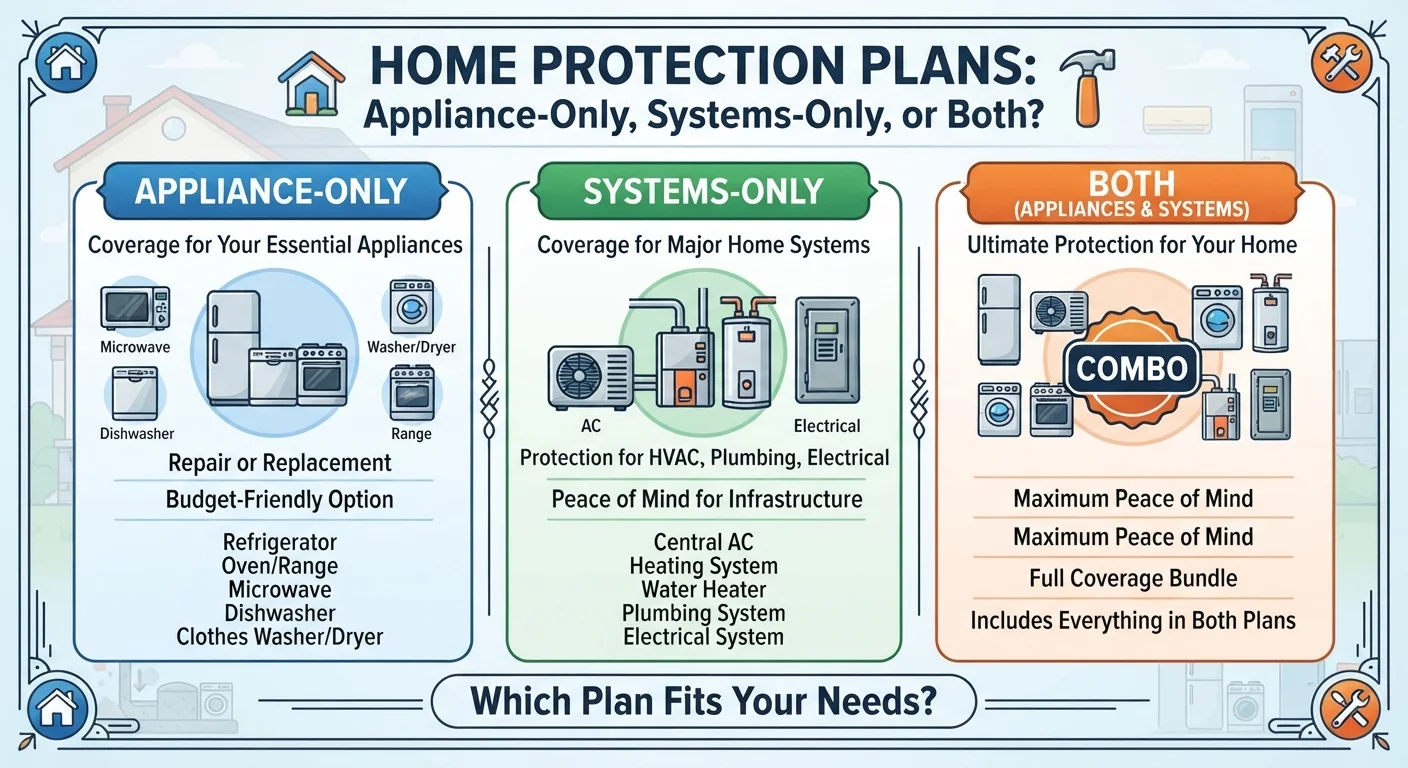
Home warranty tiers vary widely. This comparison breaks down appliance-only, systems-only, and combination plans so you can understand what each covers.
Our Verdict
No single tier is right for every household. Appliance-only plans suit homeowners whose systems are newer or still under separate coverage. Systems-only plans fit those whose major mechanical infrastructure is aging. Combination plans reduce the number of separate contracts to manage, but only make financial sense when the premium reflects the actual risk across both categories.
| Best for | Recommended |
|---|---|
| Homeowners with newer HVAC and plumbing but aging kitchen appliances | Appliance-only plan |
| Homeowners with older electrical, plumbing, or HVAC systems and recently replaced appliances | Systems-only plan |
| Homeowners whose appliances and major systems are all aging simultaneously | Combination plan |
| Homeowners still evaluating contract terms and coverage caps | Review contract language before choosing any tier |
What each tier actually covers
Home protection plans, often called home warranties, are service contracts that pay toward the repair or replacement of covered items when they fail from normal wear. Providers generally structure their plans into three tiers: appliance-only, systems-only, and combination.
Appliance-only plans typically cover freestanding and built-in household appliances: refrigerators, ovens, dishwashers, washers, dryers, and sometimes microwaves or garbage disposals. They do not cover the mechanical systems that run behind walls or in utility areas.
Systems-only plans cover the home's built-in infrastructure: heating and cooling (HVAC), electrical panels and wiring, and plumbing. Some contracts extend to water heaters, ductwork, or ceiling fans. Freestanding appliances are excluded.
Combination plans bundle appliance and systems coverage under one contract. The scope still varies by provider, so a combination plan from one company may cover fewer items than two separate single-tier plans from another.
For a plain-language explanation of terms like coverage cap, service call fee, and pre-existing condition clause, see the home warranty glossary.
| Appliance-only | Systems-only | Combination | |
|---|---|---|---|
| Typical coverage | Refrigerator, oven, washer, dryer, dishwasher | HVAC, plumbing, electrical, water heater | Both appliance and systems categories |
| Excludes | Built-in systems, infrastructure | Freestanding appliances | Varies; check contract exclusions |
| Relative annual cost | Lower than combination | Lower than combination | Higher; covers more categories |
| Useful when | Systems are newer or under warranty | Appliances are newer or under warranty | Multiple categories are aging simultaneously |
| Key risk | No help if HVAC or plumbing fails | No help if appliances fail | Higher premium may exceed actual risk |
| Overlap with manufacturer warranty | Possible on newer appliances | Possible on recently installed systems | Possible in both categories |
How to match a tier to your home's situation
The right tier depends on the age and condition of what you own, not on a general rule about which plan type is superior.
If your HVAC system was replaced within the past few years and is still under a manufacturer or installer warranty, paying for systems coverage in a home protection plan may duplicate protection you already have. An appliance-only plan could cover the items that fall outside that warranty.
Conversely, if your furnace, water heater, and electrical panel are all more than 15 years old and your kitchen was recently renovated with new appliances, a systems-only plan addresses the higher-risk items without paying for appliance coverage you may not need soon.
Combination plans are worth evaluating when multiple categories are aging at the same time. The annual premium for a combination plan is typically higher than either single-tier option, so compare it against the actual coverage limits in the contract, not just the tier label. Hidden costs inside home warranty plans walks through how service call fees and coverage caps affect your real out-of-pocket exposure.
Check what you already have covered
Before buying any tier, list the age and warranty status of your major appliances and systems. If a furnace installer provided a five-year parts-and-labor warranty, a systems plan purchased now may duplicate that coverage for several years. Identifying active warranties first helps you decide which tier, if any, adds real value for your household.
What contracts frequently exclude
Every tier has exclusions, and they matter more than the tier name when you file a claim. Common exclusions across all plan types include pre-existing conditions (failures that existed before the contract start date), improper installation, cosmetic damage, and items outside the stated coverage list.
Appliance plans often exclude commercial-grade equipment, secondary refrigerators, or appliances used in a home business context. Systems plans commonly exclude components added after original construction, outdoor plumbing lines, or low-voltage wiring. Combination plans carry both sets of exclusions.
Coverage caps also vary. A plan may cover HVAC repair up to a fixed dollar amount per claim or per year, leaving you responsible for costs above that limit. Before purchasing any tier, reading the contract carefully is the most direct way to understand what is and is not covered.
Other factors worth checking before you decide
Manufacturer warranties on newer appliances or systems may already cover repair costs for a set period. Buying a home protection plan that overlaps with an active manufacturer warranty means paying twice for the same risk during that window.
Some homeowners consider renting certain equipment, such as water heaters or HVAC units, rather than owning and insuring them separately. Renting versus owning home appliances covers the financial trade-offs of that path.
If you are comparing plans for a home you recently purchased, ask the seller for documentation on appliance and system ages. That information directly affects which tier has the most practical value. For a broader overview of the service plan landscape, the first-time buyer's guide to home service plans maps out the different contract types available to homeowners.
The content provided on our blog site traverses numerous categories, offering readers valuable and practical information. Readers can use the editorial team’s research and data to gain more insights into their topics of interest. However, they are requested not to treat the articles as conclusive. The website team cannot be held responsible for differences in data or inaccuracies found across other platforms. Please also note that the site might also miss out on various schemes and offers available that the readers may find more beneficial than the ones we cover.