
Travel Protection Plans Offered at Checkout: Worth It or Not?

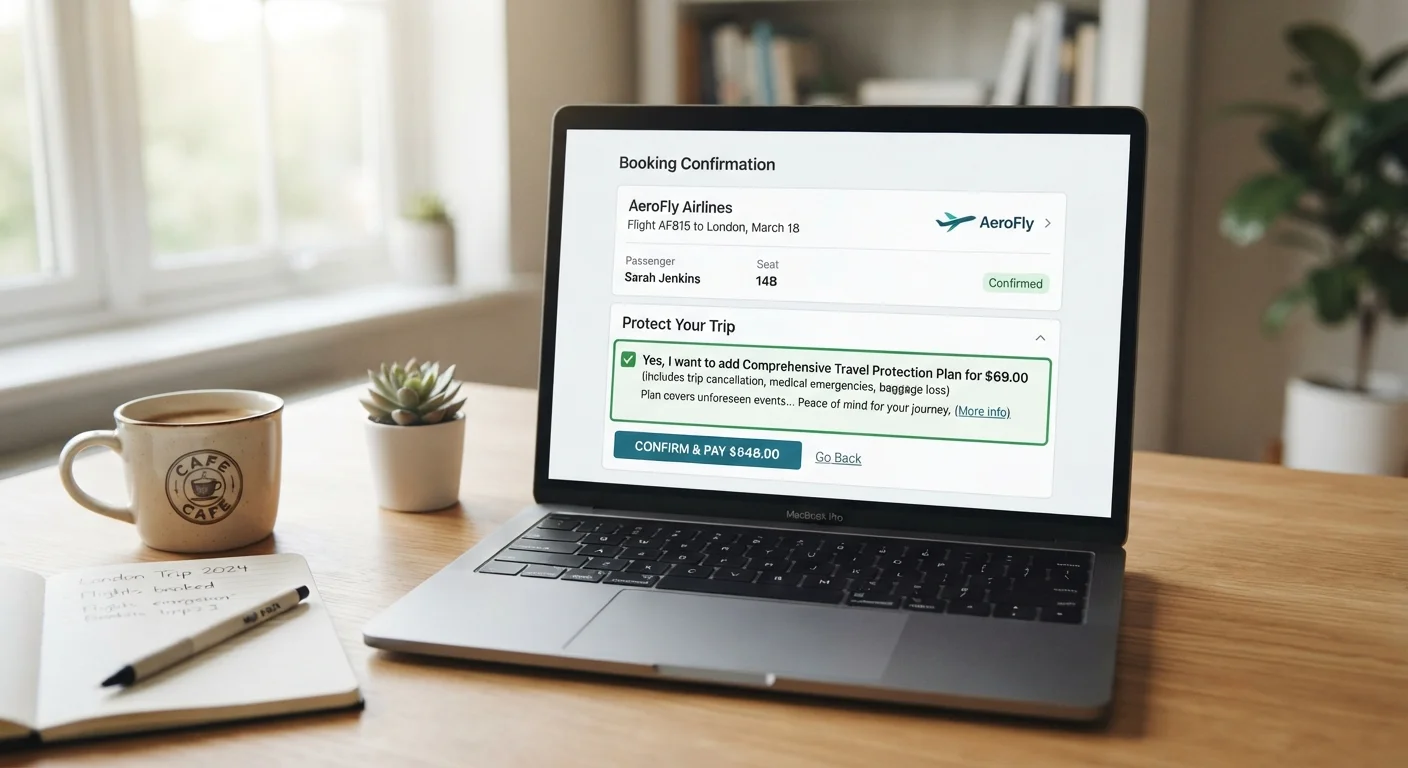
Protection plans appear at checkout on most major airline and booking sites.
Airlines and booking sites often offer their own protection plans at checkout. Learn what these typically include, what they omit, and how they compare to standalone policies.
Our Verdict
Checkout protection plans are convenient and can cover common disruptions like trip cancellations and delays. For short, low-cost domestic trips, the add-on may be sufficient. For international travel, longer itineraries, or trips with significant non-refundable expenses, a standalone policy typically provides stronger medical, evacuation, and cancellation coverage.
Travelers taking short domestic trips with modest non-refundable costs who want basic cancellation and delay coverage without comparing multiple policies.
What checkout protection plans typically cover
When you book a flight or package through an airline or booking site, a protection plan appears as an add-on before you pay. These plans are usually underwritten by a third-party insurer but sold under the platform's branding. Most include some version of the following:
- Trip cancellation reimbursement for covered reasons, such as illness, injury, or a death in the family
- Trip interruption coverage if you must cut a trip short for a covered reason
- Trip delay benefits for meals and lodging when a delay exceeds a set number of hours
- Baggage loss or delay reimbursement
- Some level of emergency medical or dental coverage
The word "covered" carries a lot of weight here. Plans define exactly which cancellation reasons qualify, and those lists can be short. A job loss, a change of plans, or a family obligation that does not meet the policy definition of a covered event typically will not result in reimbursement. See our guide to trip delay coverage for a closer look at how that specific benefit works in practice.
What these plans commonly leave out
Checkout plans are built for simplicity and speed, which means they often trade breadth for convenience. Several coverage areas deserve close attention before you accept the add-on.
Medical evacuation. Emergency medical evacuation to an adequate facility can cost tens of thousands of dollars. Many checkout plans either exclude evacuation entirely or cap it at amounts that fall well short of real costs. Medical evacuation coverage is an area where standalone policies tend to differ significantly from checkout add-ons.
Pre-existing conditions. Most checkout plans exclude pre-existing medical conditions unless you buy within a narrow window after your initial trip deposit, often 14 to 21 days. Miss that window, and a flare-up of a known condition may not be covered.
"Cancel for any reason" (CFAR). Standard checkout plans require a covered reason to cancel. CFAR upgrades, which let you cancel for any reason and recover a portion of costs, are sometimes available but add to the price and are not universal.
Your domestic health plan abroad
Most U.S. employer-sponsored and individual health plans provide little to no coverage outside the country. Medicare does not cover care abroad in most circumstances. If the checkout plan's medical benefit is the only travel medical coverage you would have, its limits deserve careful review before you decide.
Your existing health plan may not extend coverage abroad at all, which makes the medical component of any travel protection more significant than it first appears. Our article on how travel insurance works with existing health coverage explains where domestic plans typically stop.
Pros and cons at a glance
Before deciding whether to accept or skip the checkout add-on, weigh these factors against your specific trip.
Convenient, single-step purchase at checkout
The plan is added in one click without requiring separate research or account creation on a third-party insurance site, which suits travelers who want a quick decision.
Covers common, predictable disruptions
Trip cancellation due to illness, baggage delay, and overnight trip delays are well-handled by most checkout plans, covering the scenarios travelers encounter most often.
Cost is often modest relative to trip price
For shorter or lower-cost trips, the add-on fee may be proportionally small, making it a reasonable hedge against cancellation losses without detailed comparison shopping.
Pre-trip purchase timing is automatic
Buying at booking means you do not risk forgetting to purchase coverage before the pre-existing condition waiver window closes or before a named storm forms.
Medical and evacuation limits are often low
Checkout plans frequently cap emergency medical benefits at amounts that do not reflect real hospital or evacuation costs outside the United States, where charges can reach six figures.
Covered cancellation reasons are narrowly defined
If your reason for canceling does not appear on the plan's covered-reason list, no reimbursement follows. Work conflicts, family obligations, and personal decisions typically do not qualify.
Pre-existing condition exclusions apply broadly
Conditions diagnosed, treated, or showing symptoms in the months before purchase are often excluded, which affects a large share of travelers, particularly older adults.
Limited comparison or customization options
Checkout plans are take-it-or-leave-it products. You cannot adjust deductibles, raise medical limits, or add riders the way you can with many standalone policies.
May overlap with existing credit card benefits
Cardholders who already have trip cancellation or baggage protection through a card may pay for duplicate coverage without gaining additional protection.
How to decide before you book
Three questions help frame the decision. First, how much of your trip cost is non-refundable? A refundable fare with no prepaid hotel carries little financial risk if you cancel. Second, are you traveling internationally? Medical costs abroad and the lack of domestic health coverage make medical and evacuation benefits more relevant. Third, do you already have coverage elsewhere? Some credit cards include trip cancellation, delay, and baggage protection, though limits vary and cardholders should verify terms directly with their card issuer.
Use our pre-trip insurance checklist to map your existing coverage before adding a plan at checkout. Many travelers pay for overlapping protection without realizing it, while leaving genuine gaps uncovered.
Common misconceptions about travel coverage can also steer decisions in the wrong direction. Our piece on travel insurance misconceptions covers the assumptions most likely to leave travelers exposed.
This article is for general informational purposes only and is not personalized insurance, financial, or legal advice. Coverage terms, exclusions, and eligibility vary by provider and policy. Read the full policy documents and consult a licensed insurance agent before purchasing any coverage.
The content provided on our blog site traverses numerous categories, offering readers valuable and practical information. Readers can use the editorial team’s research and data to gain more insights into their topics of interest. However, they are requested not to treat the articles as conclusive. The website team cannot be held responsible for differences in data or inaccuracies found across other platforms. Please also note that the site might also miss out on various schemes and offers available that the readers may find more beneficial than the ones we cover.